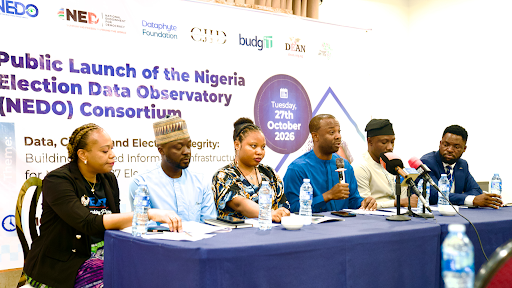
Dataphyte Foundation, Yiaga Africa, BudgIT Foundation, the Centre for Journalism Innovation and Development (CJID), and DEAN Initiative have officially launched the Nigeria Election Data Observatory (NEDO) Consortium in Abuja, ahead of Nigeria's 2027 General Elections.
The Nigeria Election Data Observatory (NEDO) is a first-of-its-kind shared election observation, data aggregation and information-sharing initiative. The five partners are pooling their networks, resources and expertise to build a broader independent evidence base across the 2027 electoral cycle.
Speaking on behalf of the Consortium, Oluseyi Olufemi, Country Director of Dataphyte Foundation, explained that the NEDO initiative is designed to bridge fragmentation in election observation, civic data management and information distribution among organisations working to protect electoral integrity and safeguard electoral information and data systems.
Nigeria's civil society organisations have long monitored elections, tracked incidents and analysed results, but often through separate networks, data management systems and communication channels. The 2023 General Elections exposed the limits of this fragmented approach, particularly when challenges with the INEC Result Viewing Portal (IReV) highlighted the need for shared civic resources to consolidate observation data and independently cross-check electoral information.
Public confidence in the electoral process also remains a concern, with 34 per cent of respondents in Yiaga Africa's September 2026 National Voting Intentions Survey expressing confidence that the Independent National Electoral Commission (INEC) would conduct credible elections. This comes amid continued public scrutiny of the Commission's preparedness and the integrity of the electoral process.
The information environment has also changed. Generative AI, deepfakes, manipulated content and misinformation can make it increasingly difficult for citizens to distinguish credible election information from false or misleading claims.
These challenges, alongside concerns about political intimidation and the changing political landscape ahead of the 2027 elections, underscore the importance of independent observation that can consistently document electoral conditions across the country.
The NEDO Consortium recognises that no single organisation can adequately respond to these challenges at the national level. Civil society therefore needs a coordinated system that connects observer networks, evidence and expertise across election administration, incidents, media, collation and results transmission, providing Nigerians with credible, independently verifiable electoral information.
To achieve this, Dataphyte Foundation, the secretariat for the NEDO initiative, has developed a shared data-aggregation and information-sharing platform that enables participating organisations to exchange election data through Application Programming Interfaces (APIs) and a simpler data-sharing system. The platform allows partners to contribute to, access, and reuse verified electoral information across their platforms and public communication channels.
The platform also incorporates automated data scraping technology designed to retrieve election results published by INEC in real time. Using AI-powered Optical Character Recognition (OCR), the system converts result-sheet images obtained from the INEC Result Viewing Portal (IReV) into machine-readable data. The system then distributes and uses this information on interactive election-result platforms operated by consortium partners, including Dataphyte Foundation and BudgIT Foundation, while making relevant electoral data accessible to the general public.
A central strength of the initiative is its pooled human network of election observers, including YIAGA Africa's Watching The Vote (WTV) network, who will provide real-time information on electoral incidents, voting processes, collation and election results. Information collected through this network will support election reporting and verification by CJID-coordinated media organisations, while also providing an independent evidence base for comparison with results published on IReV.
Alongside these activities, the Consortium will conduct pre-election surveys and situation assessments, led by DEAN Initiative, to generate evidence on electoral preparedness, citizens' perceptions, emerging risks, and the broader conditions shaping the 2027 elections. These assessments will inform the Consortium's National Election Readiness Report, regional briefs, and periodic situation reports.
The Consortium also announced the launch of the NEDO App, its civic technology tool for election observation and information management. Field observers from the five organisations and other partners joining the initiative will use the application during the elections to document developments across the electoral process, including election administration, incidents, collation and results.
Abdulahi Adebayo, Programme Manager at Dataphyte Foundation, explained that the application will feed information into a shared evidence repository accessible to consortium partners for analysis, reporting, visualisation, advocacy, and public communication.
The NEDO initiative is designed to address potentially conflicting reports, result discrepancies, misinformation and allegations of irregularities that often arise when organisations work in silos. Rather than relying on separate datasets, consortium partners can cross-check information across observer networks, verify competing claims, identify inconsistencies, and communicate findings based on a wider body of evidence.
By combining their capacities in election observation, research, media monitoring, civic technology, data analysis and citizen engagement, the five organisations, alongside other partners participating in the initiative, will expand independent scrutiny of the electoral process. This coordinated approach will help civil society respond more effectively to attempts to manipulate or misrepresent electoral information and provide citizens with evidence they can independently assess.
For the 2027 General Elections, the Consortium plans to deploy over 4,000 observers through its member organisations' networks, extending monitoring across polling units and different levels of result collation.
NEDO's work will cover the full electoral cycle. Before the elections, the Consortium will assess electoral conditions, citizen preparedness and public confidence, and produce a National Election Readiness Report, regional briefs and periodic updates. During the elections, observers' information will feed into the shared system for verification and public communication, alongside election results obtained from INEC. After the polls, the Consortium will analyse its evidence alongside official results, publish a post-election report and make relevant data available for research, advocacy and electoral reform.
Through this collective effort, the five organisations reaffirm their commitment to strengthening independent election observation, electoral transparency and public access to credible information. By working from a common evidence base, NEDO seeks to strengthen civil society's capacity to independently monitor the electoral process and provide Nigerians with credible, verifiable information before, during and after the 2027 General Elections.
Media Enquiries
Funmilayo Babatunde
For NEDO Consortium Secretariat
[email protected]
08116665321
Citation
Dataphyte Foundation (2026). “Dataphyte, BudgIT, CJID, Others Launch NEDO Consortium for 2027 Elections.” Dataphyte Foundation. Available at: /election/dataphyte-budgit-cjid-others-launch-nedo-consortium-for-2027-elections
Blog

Strengthening Women Economic Justice in West and Central Africa: Dataphyte Foundation and Christian Aid Hold Inception Workshop