Nigeria Is Getting Hotter: How Above-Normal Temperatures in 2026 Will Change Daily Life

Nigeria Is Getting Hotter: How Above-Normal Temperatures in 2026 Will Change Daily Life

Published on May 29, 2026

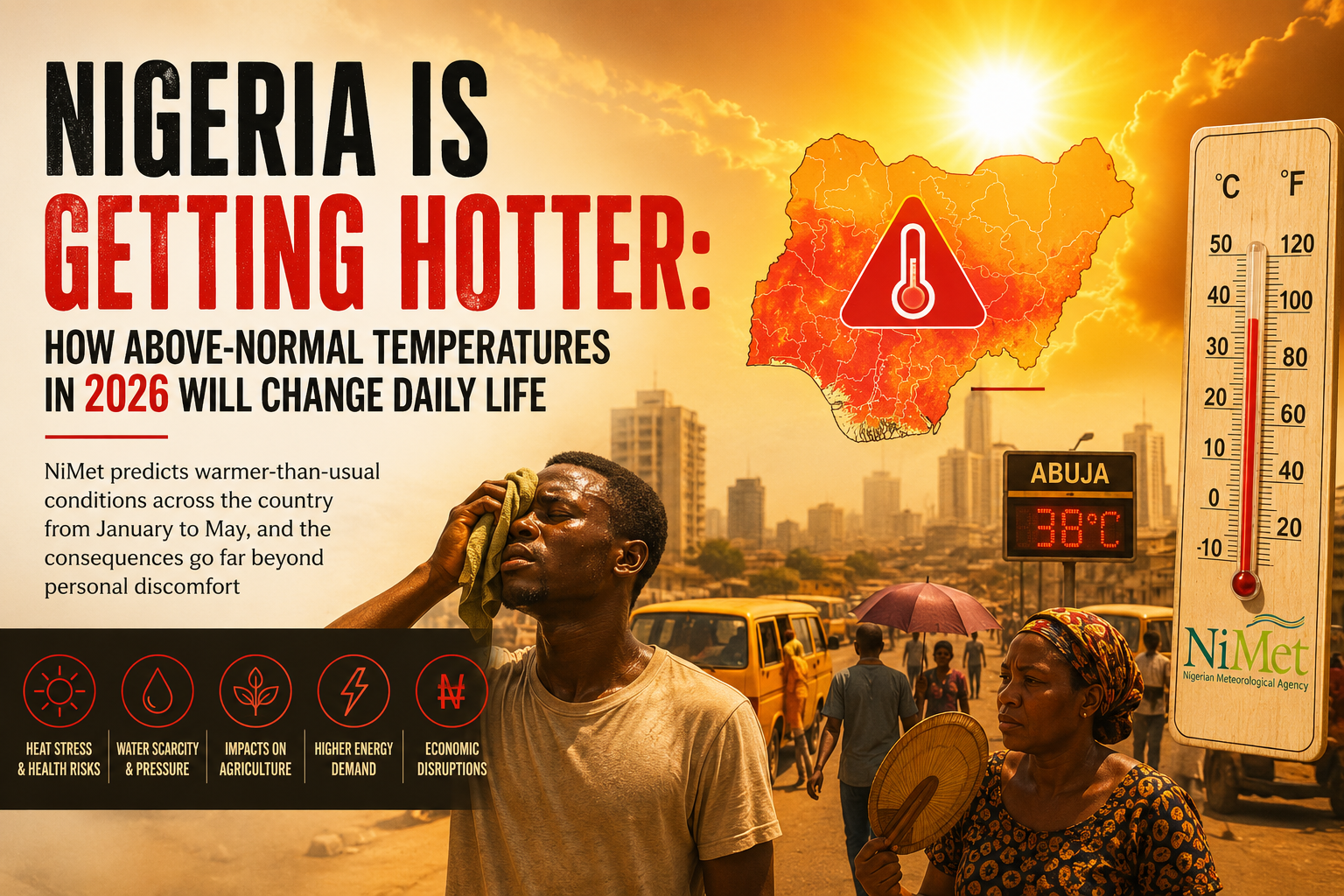
NiMet predicts warmer-than-usual conditions across the country from January to May, and the consequences go far beyond personal discomfort

Mrs. Fatima Usman wakes up at 4:30 a.m. every morning in Kano to start cooking and prepare her children for school before the heat sets in. By 9 a.m., her kitchen, a small room with one window, is already unbearable due to the intense heat trapped within its walls. By noon, her children refuse to do anything. By 3 p.m., she is already rationing water because the borehole yield is lower than usual. Her whole day is organised around the heat.

In 2026, according to NiMet’s 2026 Seasonal Climate Prediction Report, Mrs. Fatima routine is going to be harder because temperatures across Nigeria are expected to be above the long-term average, meaning hotter than what Nigerians are already used to across most of the country for the first five months of the year.

"

"Temperatures are expected to be generally above the long-term average across the country. Both daytime and nighttime temperatures are predicted to be warmer than the long-term average over most parts of the country in January, February, March, April, and May 2026."

— NiMet 2026 SCP

Notice the important part, “nighttime”. It is not only the afternoon sun that will feel hotter than usual. Even at night, the time when many Nigerian families normally get some relief from the heat, sleeping outside on mats or leaving windows open for fresh air the temperature will remain high.

This makes heat harder for people to cope with. There is little or no time for the body to cool down and recover before the next hot day begins.

What Above-Normal Temperatures Do to Human Health

Heat stress is one of the most underreported health threats in Nigeria. It does not make headlines the way floods or cholera outbreaks do, but it kills silently, particularly among the elderly, young children, outdoor workers, and people with underlying health conditions.

When temperatures are consistently above normal for five months from January through May, the human body is under sustained physiological stress. Dehydration becomes more likely. Heat exhaustion can progress to heat stroke, which is a medical emergency. For people who work outdoors including construction workers, motorcycle taxi riders, market traders, farmers, the risk is compounded by the fact that they cannot simply stay indoors.

Nighttime temperatures above normal also disrupt sleep, which weakens immune function and reduces productivity over time. A population that is not sleeping well, because the heat that used to break at sundown no longer does, is a population that is subtly less healthy, less alert, and less productive across the board.

What It Means for Nigerian Farmers

The 2026 SCP's agricultural section explains the damage that above-normal temperatures inflict on crops in detail. High temperatures, particularly during periods of dry spells, cause heat stress in crops, leading to reduced photosynthesis, stunted growth, and lower yields. They increase evapotranspiration, resulting in higher water demand and rapid soil moisture loss.

Heat also negatively affects flowering and pollination, causing poor grain or fruit set. It accelerates crop maturity, producing smaller grains and reduced quality. High temperatures encourage pests, diseases, and weed proliferation. And in severe cases, heat combined with drought leads to crop failure, reduced seed quality, and major economic losses for farmers.

"

"High temperatures, particularly during periods of dry spells, can cause heat stress in crops, leading to reduced photosynthesis, stunned growth, and lower yields…In severe cases, heat combined with drought leads to crop failure, reduced seed quality, and major economic losses for farmers."

— NiMet 2026 SCP

What It Means for Livestock

The 2026 SCP raises explicit concerns about the period from February to April, when above-normal temperatures will overlap with the pre-planting season for many farmers. Livestock farmers are told to monitor animals closely for weight loss and heat (mating) loss during this period. Poultry farmers are warned to fortify water with electrolyte supplements and vitamins (A, C, D, E) to reduce heat stress, especially between February and April.

Farmers are advised to improve ventilation in poultry houses through ridge vents, fans, and foggers to reduce heat stress and mortality, and to use water sprinklers or misters in the afternoon. Cattle and small ruminant farmers are told to adjust grazing and feeding schedules to cooler parts of the day such as early morning or late evening to reduce heat exposure and to provide shade and ventilation, especially between February and May.

What It Means for Aviation and Roads

Above-normal temperatures also affect Nigeria's infrastructure in ways that are not always obvious. High temperatures cause asphalt to soften, crack, or deform, creating hazardous driving conditions. Increased tyre blowouts occur due to overheating on long-distance routes. Heat can weaken bridge joints and expansion plates, affecting structural stability over time.

For aviation, the 2026 SCP warns of strong temperature inversions caused by warmer-than-normal temperatures, which cause wind shear and can lead to loss of aircraft control. Above-normal temperatures also increase stress on aircraft engine performance and fuel consumption, leading to higher costs of operation.

The Energy Demand Crisis

For Nigeria's already strained electricity grid, hotter temperatures mean higher demand. When temperatures are above normal, air conditioning units and fans run longer. Industrial cooling systems work harder. The peak demand on the grid increases at exactly the time when most Nigerians are already struggling with unreliable power supply.

For the millions of Nigerians who rely on generators during the hottest hours of the day, above-normal temperatures in January-May 2026 will mean higher fuel bills. Petrol and diesel consumption will increase simply because generators run longer. The cost of staying cool is not trivial for Nigerian households spending 20–30% of their income on energy.

What Nigerians Can Do

NiMet's advisories acknowledge the human dimension of rising temperatures. For households: stay hydrated, limit outdoor exposure during peak heat hours, and monitor children and elderly relatives carefully. For farmers: plant early-maturing varieties, adjust planting dates to avoid peak heat periods, use mulching to conserve soil moisture, and practice agroforestry or shade management. For livestock farmers: provide shade and ventilation for animals from February through May.

For the government, the 2026 data is a call to action on heat adaptation: building codes that require better ventilation, urban planning that accounts for heat islands in dense cities like Lagos and Kano, and health early-warning systems that alert communities when heat index levels become dangerous.

Nigeria is getting hotter. The 2026 data does not just say that temperatures will be above normal. It says that for five consecutive months from January through May, the country will be living in a heat environment that exceeds what people have historically known as normal. Adapting to that reality is not optional, it is survival.

Blog