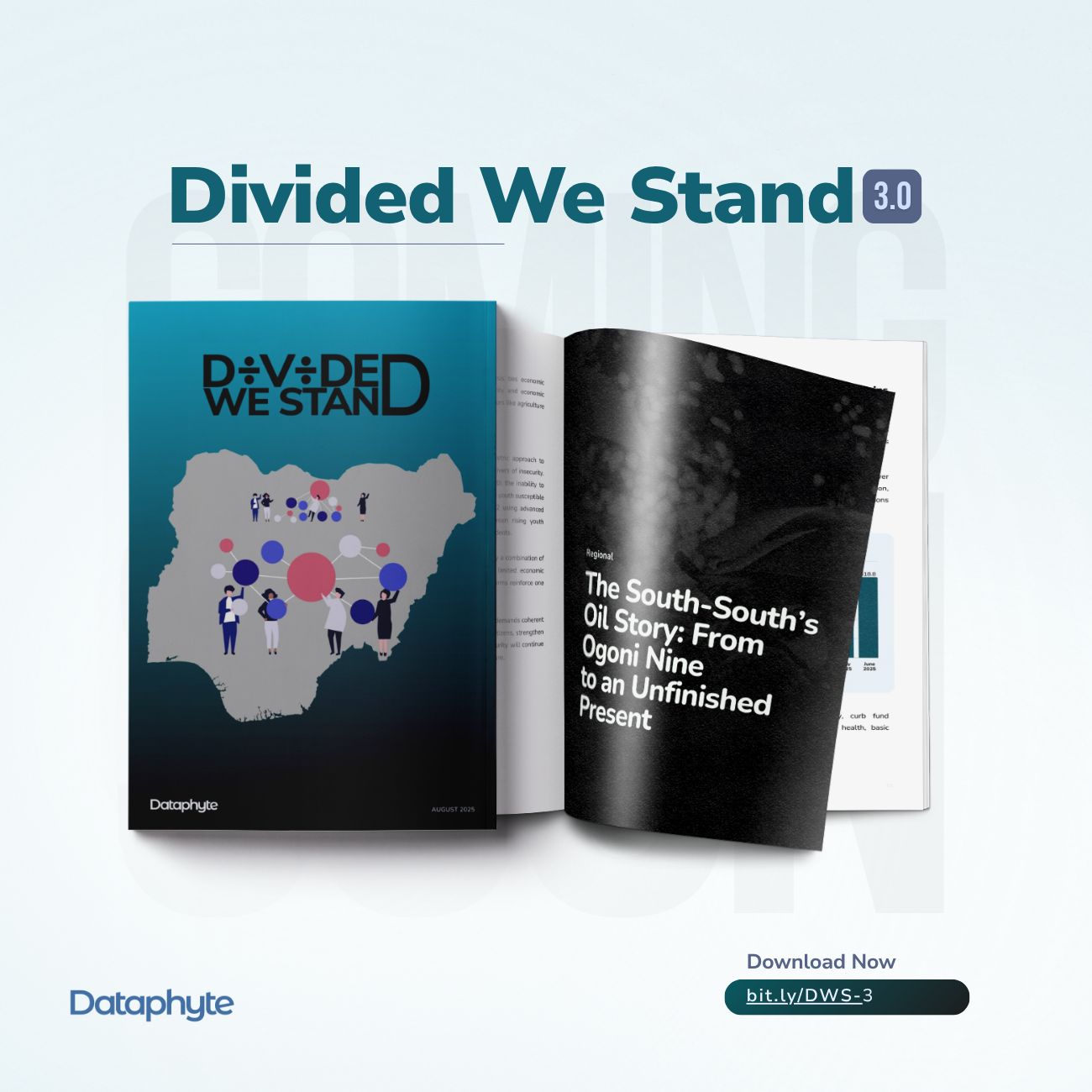
When Dataphyte began working on this edition of Divided We Stand, the aim was to confront and tackle the structures prolonging Nigeria’s challenges, structural inequality and institutional fragility. From the mass violence claiming thousands of lives across the North to the environmental degradation that continues to poison the South-South, the report pieces together issues of conflict, corruption, and weak governance that define Nigeria’s lived reality.
The report was conceived as a national mirror, one that reflects both the scale of Nigeria’s crisis and the opportunities buried within them.
At the national level, it tells a story of a country in crisis. Over 114,000 deaths have been linked to insecurity between 2016 and 2025, despite record defence budgets. Also, it shows how economic hardship, unemployment, and corruption fuel a cycle of violence that government spending alone cannot fix. The findings are as uncomfortable as they are necessary. Insecurity in Nigeria is not random, but systemic.
At the regional level, the environmental crisis that the Ogoni Nine protested nearly 30 years ago still remains. The data and analysis reveals how the same issues (pollution, oil spills, and unfulfilled promises) still define the region’s relationship with the state and multinational corporations. Also, the story of Ken Saro-Wiwa’s activism remains an unfinished struggle for justice, one that continues to echo through new environmental movements and legal battles.
The state section turns attention to Osun and Ekiti, the two states preparing for off-cycle elections in 2026, where political participation continues to decline. Beneath the data is a question that touches every democracy, when citizens lose faith in governance, what happens to accountability?
At the local government level, the report zooms into Orumba South LGA in Anambra State. The data also showed that Orumba South ranked as the 9th most populated local government area among the 21 LGAs in Anambra State. The economy of Orumba South is primarily driven by agriculture, which remains the main source of livelihood for a majority of its residents. The region’s favourable climate and fertile land make it suitable for cultivating staple crops such as yams, cassava, maize, and vegetables.
The ward-level focus on Gwange II in Maiduguri, Borno State, explores life in a community caught between insecurity and climate vulnerability. It is mostly inhabited by the Kanuri, Hausa, Shuwa Arabic-speaking, Fulani, Bura, and Marghi ethnic groups.
The FAAC section evaluates how over N4.47 trillion in allocations remains underutilised one year after local government financial autonomy in the midst of bureaucratic gridlocks.
The realities captured in this Divided We Stand, Edition 3.0 are very pressing. Insecurity persists; the oil region’s wounds remain unhealed; and civic participation is still waning. The report is not just a record of what is wrong, it is also a call to rethink governance from the ground up.
I urge you to download and read this report. Read it not merely as a report, but as a guide to every policymaker, journalist, and citizen who believes Nigeria can still be rebuilt.