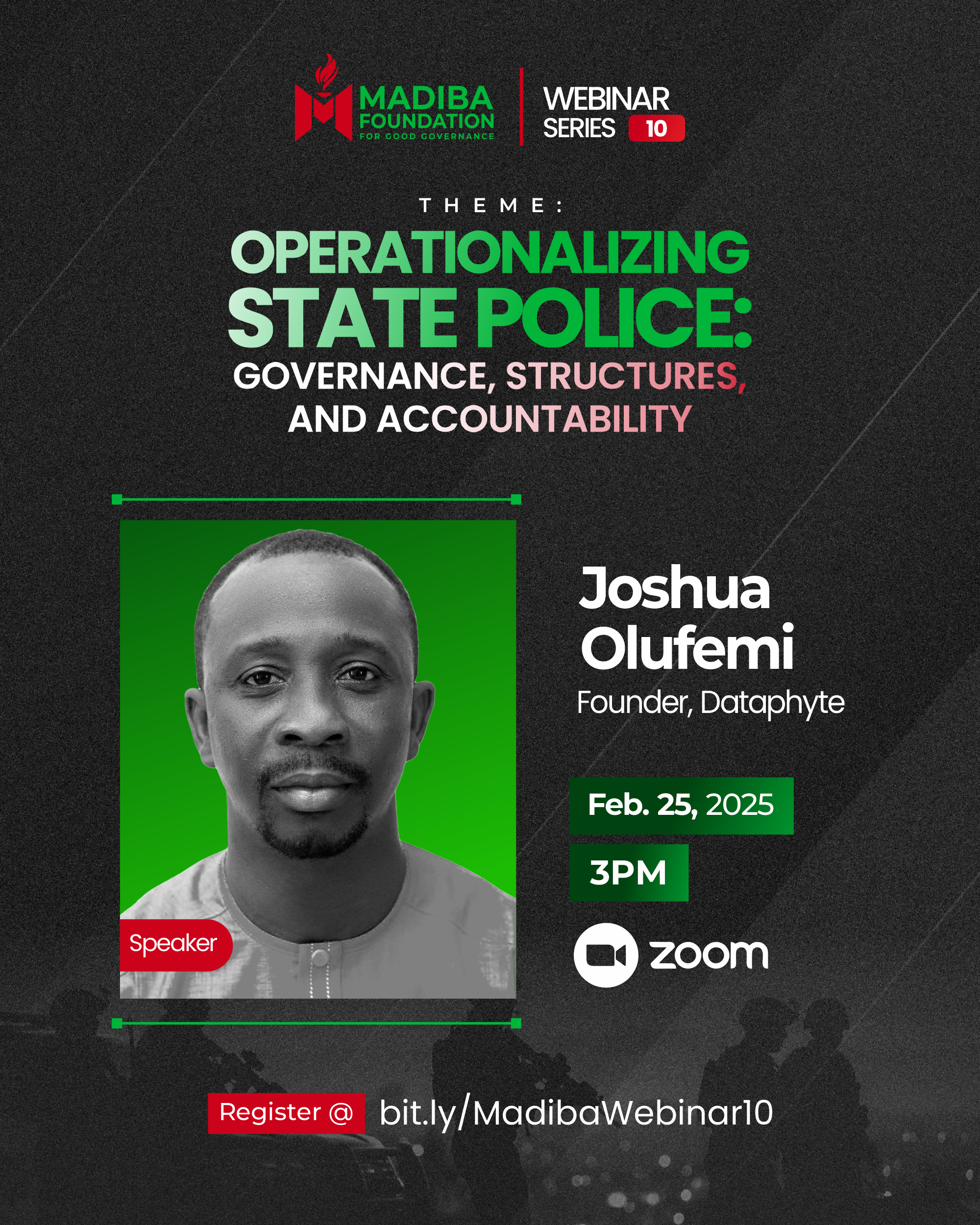
At the Madiba Foundation Webinar Series 10, convened by the Madiba Foundation as part of its ongoing policy dialogue series, stakeholders gathered to interrogate one of Nigeria’s most urgent governance questions: the operationalisation of state police. The timing of the conversation was significant. It comes amid renewed national attention following President Bola Ahmed Tinubu’s recent push to advance discussions around decentralising policing in Nigeria. With the presidency signalling fresh momentum on the issue, the webinar focused squarely on what state policing would require in practice, particularly around governance structures, accountability mechanisms, financing models, and institutional safeguards.
The Founder of Dataphyte Foundation, Joshua Olufemi who was one of the guest speakers, approached the issue from a governance standpoint. His central argument was that Nigeria must first examine the weaknesses in its current policing framework before attempting to replicate it at the state level.
“We are not starting from zero,” he noted. Structures for oversight, recruitment, and community engagement already exist within the federal policing architecture. The challenge, however, is that many of these systems are weakened by limited independence, insufficient funding, and poor transparency. Without addressing these gaps, creating state police risks reproducing the same structural flaws.
One key example he referenced was the Police Service Commission, the body responsible for oversight of the Nigeria Police. While it is designed to serve as a civilian accountability mechanism, its limited budget and operational constraints have reduced its impact. For Olufemi, this highlights a broader lesson; oversight bodies must be empowered, properly funded, and institutionally independent if they are to function effectively.
Political capture was another major concern raised during the session. At the state level, where executive and legislative arms may be politically aligned, formal separation of powers does not always guarantee practical independence. “During election periods,” he observed, “institutions can begin to move in the same direction.” In such contexts, oversight mechanisms controlled solely by government actors may not be sufficient.
This is where citizen involvement becomes critical. Olufemi pointed to Community Policing Committees, which are already recognised in law but remain largely under-operationalised. These committees, if properly structured, could provide transparent complaint systems and create meaningful channels for citizen participation. Embedding citizen oversight, he argued, could serve as a safeguard against abuse and political manipulation.
Transparency in recruitment and operations also featured prominently in the discussion. Referencing the recent recruitment of thousands of constables, Olufemi questioned the limited public visibility surrounding the process. “Who are these people? Where are they from? What is their background?” he asked. Without clear, publicly accessible information about recruitment standards and background checks, trust in the system is undermined.
He extended this concern to state-backed security outfits, noting that visibility without transparency can create legitimacy gaps. Recruitment processes must be open and merit-based, not opaque or politically influenced.
On the issue of police-to-citizen ratios, Olufemi cautioned against relying solely on global benchmarks such as the United Nations guideline of one officer to 450 citizens. While standards provide useful reference points, he argued that deployment must be context-specific and data-driven. Crime hotspots, population density, and accessibility should determine officer distribution.
“It’s not enough to parade thousands of officers,” he said. “The question is whether they are accessible and able to provide the service.” Increasing numbers without improving responsiveness and service quality may fail to improve citizens’ lived experience of safety.