
Education, Health, And Social Investment
Strengthening Governance And Financing In Health Supply Chains: Evidence From Nigeria’s SSTS Initiative
June 11, 2026 · Kehinde Abdulkadir
Nigeria’s health supply chain crisis is preventing people from receiving timely care. In many primary healthcare centres, essential medicines remain unavailable.
Introduction
Across Nigeria’s primary healthcare centres, a dangerous pattern continues to undermine healthcare delivery: essential medicines are frequently unavailable. For patients seeking maternal healthcare, malaria treatment, or routine medical services, these stockouts are not merely logistical lapses, but symptoms of governance failures; fragmented procurement processes, weak institutional accountability, parallel donor-driven supply chains, and inadequate domestic health financing have collectively contributed to delays in treatment and, in severe cases, preventable deaths, particularly among mothers and newborns. According to the 2023 UN inter-agency estimates, Nigeria accounts for approximately 28.5% of global maternal deaths, the highest burden of any country in the world.
This brief draws on evidence from the Strategic Support to Targeted States (SSTS) initiative to Improve Supply Chain Performance. Where governance structures were strengthened and domestic financing expanded, the results were striking: oxytocin stockouts fell from 14% to 1%; misoprostol stockouts from 34% to 11% in Kaduna State; malaria RDT stockouts in Nasarawa fell from 5% to 2%; and sulfadoxine (SP) stockouts fell from 27.5% to 10%.
The paper identifies five actionable recommendations: ensure BHCPF allocations are dedicated to essential medicines; establish minimum Drug Management Agency (DMA) governance standards; embed supply chain accountability in legislative oversight; and adopt a phased, readiness-based scaling strategy.
Policy Context
Nigeria’s efforts to strengthen health supply chains are taking place within a broader policy environment shaped by three interlinked frameworks: the National Health Supply Chain Strategy (2021–2025), the Basic Health Care Provision Fund (BHCPF), and Nigeria’s commitment to Universal Health Coverage (UHC). Together they shape how health commodities are financed, governed, and delivered across the health system.
A. The National Health Supply Chain Strategy (2021–2025)
Nigeria’s most comprehensive health supply chain reform framework, the National Health Product Supply Chain Strategic Development and Implementation Plan (2021–2025), sets out a roadmap for government-led and integrated supply chain systems, placing state governments at the centre of supply chain governance as institutions accountable for performance and service delivery. The strategy has four major pillars: optimising leadership and governance of the National Products Supply Chain Management Programme; increasing state ownership of supply chain functions; achieving integration of supply chain operations; and optimising procurement and supply cycle value chains. Translating this vision into operational reality requires deliberate investment in state institutions, many of which remain structurally weakened by the same parallel donor-driven systems the strategy is intended to replace.
B. The Basic Health Care Provision Fund (BHCPF)
The BHCPF, established under Section 11 of the National Health Act 2014, represents the most significant dedicated primary healthcare financing mechanism in Nigeria’s legal framework. Peer-reviewed studies document persistent implementation challenges: inconsistent disbursement timelines, variable state uptake, weak accountability structures, and limited earmarking for commodity-specific expenditure. In many states, BHCPF funds flow into general PHC facility accounts rather than being designated for essential medicines, a governance choice, not a technical failure.
C. Universal Health Coverage (UHC)
The link between supply chain performance and UHC is direct: access to essential medicines is a core component of health service coverage. When medicines are unavailable at primary health centres, patients may delay treatment, seek care at higher cost, or go without care altogether. As Nigeria advances toward UHC, supply chain performance is a critical indicator of whether health services are truly accessible and effective.
The Issues
A. The Parallel Donor-Funded Supply Chain System
Over two decades, Nigeria’s health supply chain has been shaped by the proliferation of parallel supply chains established by donors and global health programmes, each with its own procurement, warehousing, distribution, and reporting mechanisms. While these arrangements expanded access to specific commodities in the short term, they produced three systemic issues:
i. Institutional Bypass: Commodities were procured and distributed independently of state Drug Management Agencies (DMAs), reducing incentives for states to invest in their own supply chain capacity since essential medicines arrived regardless of whether the state system functioned.
ii. Financing Dependency: Commodity availability became contingent on donor funding cycles rather than domestic resource allocation. When priorities shifted, states lacked the institutional infrastructure to maintain commodity flows independently.
iii. Accountability Fragmentation: Responsibility was distributed across so many actors and reporting lines that no single institution held clear accountability for system outcomes
B. Governance Issues
Three intractable challenges explain the gap between policy and practice:
i. Weak state-level institutional capacity: In many states, DMAs exist but lack the staffing, financing, or authority to function as genuine coordinating institutions.
ii. Inadequate domestic financing: Despite the BHCPF being established under Section 11 of the National Health Act 2014 and funded by a minimum of 1% of the Consolidated Revenue Fund, disbursements have been inconsistent and allocations are rarely earmarked for essential commodities.
iii. Accountability deficits: Supply chain performance is not systematically measured, publicly reported, or politically consequential at the state level, reducing pressure for improvement.
The Strategic Support to Targeted States (SSTS) Initiative
A. Pre-Reform System Conditions
Before the initiative, participating states reflected the characteristics of the national system. DMAs were operationally limited: understaffed, underfinanced, and without authority to coordinate across parallel supply chains. State pharmaceutical budget allocations were minimal; LMIS reporting was weak, with low completeness and significant lags. These conditions are consistent with patterns documented across multiple Nigerian states in peer-reviewed literature, lending the SSTS cohort validity as representative cases while acknowledging that state-level variation limits direct generalisation.
B. Key Governance and Financing Reforms
i. Institutional Governance
The most significant change was operationalising state DMAs as genuine coordinating institutions rather than merely procurement depots. This involved multi-stakeholder governance structures (Ministry of Health, DMA, programme managers, private sector), deployment of governance staging tools to assess institutional maturity, and state workplans aligned to the National Strategy. Critically, this architecture persists beyond any single programme or donor relationship: the DMA and coordination structures remain when the SSTS project closes.
ii. Financing Reform
States embedded supply chain financing into annual budget processes, creating a recurrent appropriation logic, the expectation that the state funds its supply chain as a routine government function, not a project activity. Several states increased dedicated budget allocations for essential medicines procurement, and the project facilitated structured engagement with private sector partners, demonstrating the feasibility of a mixed-financing model.
iii. Supply Chain Integration
A phased process of consolidating supply chains currently managed as separate public health programmes often supported by development partners (malaria, reproductive health, and other vertical programmes) into the state-led Essential Medicines Programme. The aim is to transition from parallel programme-specific systems into a unified state-run supply chain architecture, reducing duplication in warehousing and distribution and strengthening end-to-end visibility of health commodity flows.
C. Outcomes
Available data from endline assessments and LMIS reports show the following changes in commodity availability between 2022 (baseline) and 2024 (endline). Kaduna State data covers 100 health facilities (71 PHCs, 28 Secondary, 1 Tertiary); Nasarawa State data covers 77 health facilities (59 PHCs, 17 Secondary, 1 Tertiary):
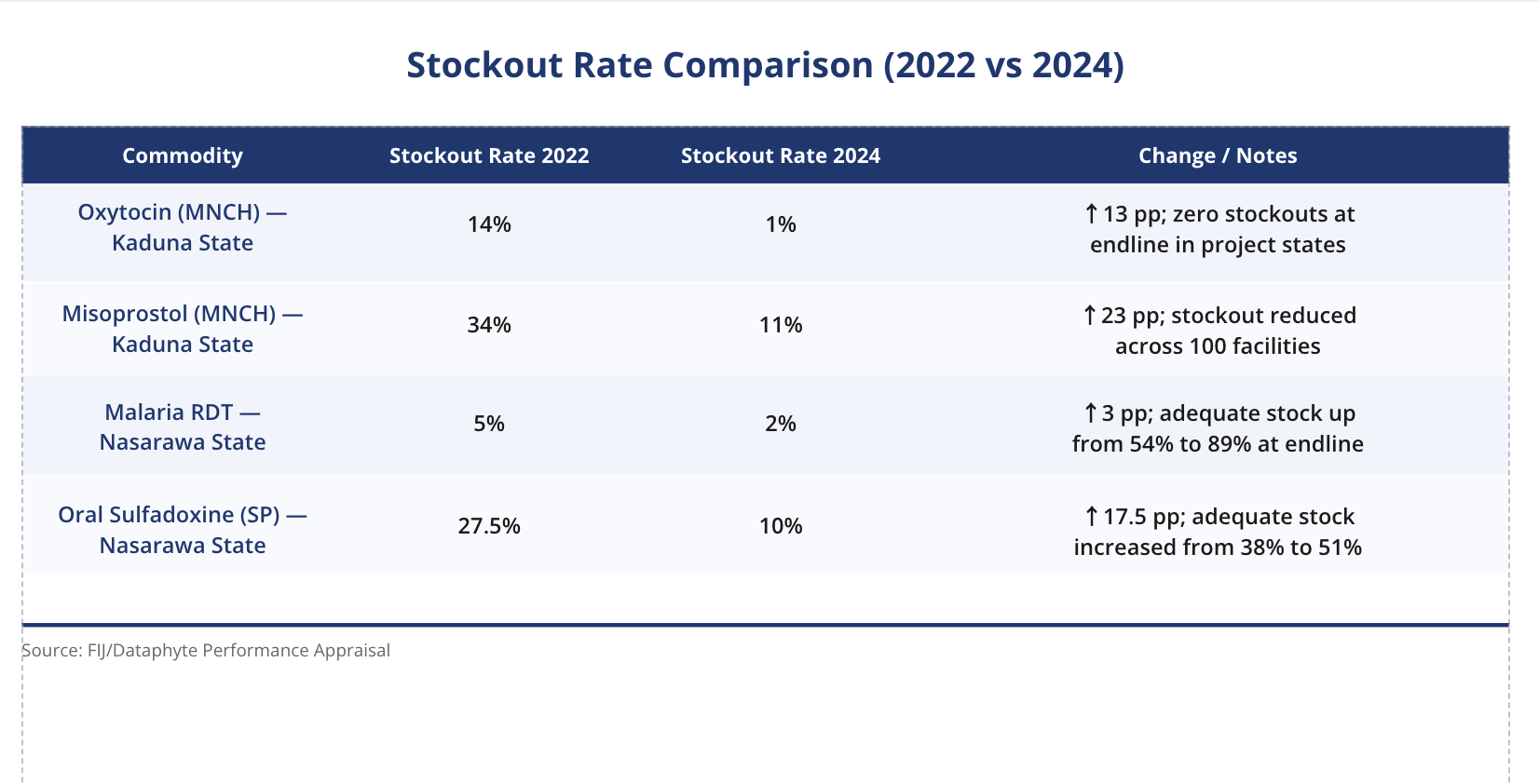
Beyond improvements in stock availability, facility-level HMIS data suggest associated improvements in downstream service delivery, including increases in antenatal care attendance and broader PHC utilisation during the project period. These associations are suggestive, not causally definitive, but are consistent with a plausible mechanism: when medicines are reliably available, patient confidence that attending a PHC will result in treatment increases utilisation.
D. Within-Cohort Variation and Comparison States
State LMIS and assessment data provide a partial, indicative comparison: states outside the SSTS cohort did not experience comparable improvements in oxytocin and misoprostol availability over the same period. More analytically revealing are differences within the SSTS cohort: outcomes were strongest where DMA operationalisation was most complete, where domestic budget allocations were actually increased (not merely committed), and where state political leadership demonstrated consistent engagement. Governance quality predicted supply chain performance.
Recommendations and Implementation Strategy
Five lessons emerge from the analysis, each with direct policy implications:
i. Institutional governance must be actively constructed, not assumed
DMAs with statutory mandates do not become functional institutions simply by existing. Active investment is required to close the gap between formal mandate and functional reality. The FMOH should define and publish minimum operational standards for state DMAs, covering staffing, financing, coordination mandate, and reporting and link BHCPF disbursement eligibility to compliance with these standards.
ii. Financing reform is governance reform
Supply chain sustainability cannot be achieved by improving operations while leaving financing structures unchanged. The transition from donor-financed to state-financed commodity procurement is a governance transition that requires explicit budget commitments. The Federal Government should introduce binding regulations requiring at least 30% of BHCPF allocations to be designated for pharmaceutical commodity procurement and reported separately in state health accounts.
iii. Integration requires political management; accountability must be embedded in legislative architecture
Supply chain integration is technically straightforward in design and politically complex in execution. Programme partners and global health funds have legitimate institutional interests in maintaining separate channels, creating structural resistance that must be explicitly managed. State Ministries of Health and DMAs should be required to present annual supply chain performance reports to State Houses of Assembly, embedding oversight in institutions that survive changes in programme partnerships.
iv. Data systems enable accountability only when actively used
The FMOH and NPHCDA should jointly develop and publicly host a quarterly supply chain performance dashboard publishing stockout rates by commodity and state, with full public access and media-ready data downloads.
v. Reforms must be designed for political sustainability, requiring sequenced scaling
Governance reforms are vulnerable to political transition. Where reforms were embedded primarily through relationships with individual officials rather than institutionalised systems, processes, and budgets, the risk of reversal was higher. The Federal Government should prioritise BHCPF disbursement support and technical assistance to states demonstrating institutional readiness, with a defined timeline toward universal DMA operationalisation by 2030.
Scaling and Implementation Pathways
Federal Government: Define minimum DMA governance standards; maintain and publish national LMIS dashboards; enforce BHCPF disbursement timelines and earmarking requirements; provide technical assistance for DMA operationalisation.
State Governments: Operationalise DMAs as genuine coordinating institutions; establish dedicated budget lines for essential medicines; integrate parallel supply chains; participate in national performance reporting.
Local Governments: Ensure PHC facilities are reported in the LMIS; facilitate community accountability mechanisms; participate in BHCPF governance at the LGA level.
Implementation Strategy
Phase | Target States | Priority Actions |
Phase 1 (2026–2027) | SSTS states + states with functional DMA infrastructure | System optimisation: supply chain integration, BHCPF earmarking, performance reporting |
Phase 2 (2027–2028) | States with moderate DMA capacity and political receptivity | DMA operationalisation, BHCPF earmarking, LMIS strengthening |
Phase 3 (2028–2030) | Remaining states and FCT | Foundational institutional reforms, supported by federal technical assistance |
Table 2: Proposed Phased Scaling Strategy (2026–2030).
Sequencing criteria should include: DMA legal status and operational history; LMIS infrastructure and reporting rates; state budget commitment; and civil society capacity to support accountability.
Accountability Mechanisms: Embedding Reform Ahead of 2027
The 2027 election cycle creates a specific accountability opportunity. Supply chain performance measured by stockout rates for essential medicines is a governance outcome that is measurable, meaningful to citizens, and directly attributable to state government action. Recommended mechanisms include:
i. National Supply Chain Dashboard: Federal Ministry of Health to host a quarterly-updated public dashboard displaying stockout rates by commodity and state, sourced from LMIS data, operational by end of 2026.
ii. Mandatory Quarterly Reporting: Required from all states as a condition of BHCPF disbursement, to submit quarterly LMIS data for public reporting.
iii. Legislative Oversight: State Houses of Assembly to receive annual DMA supply chain performance reports and hold public hearings, embedding accountability in the legislative architecture.
iv. Civil Society Monitoring: Civil society organisations with PHC monitoring capacity to be resourced to independently verify facility-level commodity availability and publish findings ahead of the 2027 elections.
Nigeria’s health supply chain failures are, at their root, governance issues. Medicines exist; the infrastructure exists; the policy frameworks exist. What has been missing in many states is the institutional capacity, domestic financing commitment, and accountability architecture to translate these assets into reliable commodity availability at the point of care.
The SSTS experience offers qualified but important evidence that these failures are addressable. Where DMAs were operationalised, domestic financing expanded, and parallel supply chain arrangements progressively integrated, commodity availability improved significantly. Oxytocin stockouts fell from 14% to 1%. Misoprostol stockouts from 34% to 11%. Malaria RDT and SP availability improved markedly in Nasarawa State. These are not incremental improvements; they represent a qualitative change in system reliability with direct implications for maternal health outcomes.
As Nigeria approaches 2027, the question is whether these lessons will be embedded in national policy and state practice, or whether the improvements achieved in reforming states will remain islands of performance in a sea of systemic underinvestment. The policy instruments are available. The evidence base is growing. What is required now is the political will to act on both.
Data Sources
ARC_ESM / Gates Foundation. (2024). SSTS Endline Assessment — Kaduna State: Oxytocin and Misoprostol. Facility-Level LMIS Data. Abuja: ARC_ESM. [See Ref. 3.] [Internal data — available from corresponding author on request.]
ARC_ESM / Gates Foundation. (2024). SSTS Endline Assessment — Nasarawa State: Malaria RDT and Oral Sulfadoxine. Facility-Level LMIS Data. Abuja: ARC_ESM. [See Ref. 3.] [Internal data — available from corresponding author on request.]