
National Security
Police Reform, State Capacity and the Limits of Decentralised Policing in Nigeria
June 16, 2026 · Tosin Osasona
Nigeria’s Fourth Republic has been defined by multiple security crises, driven largely by a range of armed non-state actors. Across the world, policing is both a labour-intensive and capital-heavy pure public...
Introduction
Nigeria’s Fourth Republic has been defined by multiple security crises, driven largely by a range of armed non-state actors. Jihadist groups in the Northeast, bandits in the Northwest, pastoralist-farmer conflicts in the north-central region, secessionist agitators in the southeast and gangs and cults in the Southwest and South-South have continuously challenged the state’s authority and questioned its viability.
The humanitarian and economic costs of these security crises have been prohibitive- the economic cost of the security crisis in the Northwest geopolitical zone alone between 2008 and 2021 is estimated to be between 90 and 113 billion dollars;,conflict-related deaths in Nigeria in 2025 are approximately 12,000, and more than 3.5 million Nigerians are displaced due to conflicts.
Research has consistently attributed the systemic failures of the Nigeria Police Force as a key catalyst in the exacerbation of the country’s security crises. This causal link logically explains the growing momentum behind public and political campaigns to overhaul the current centralised system.
Empirically, the Nigeria Police Force suffers from a deficit of legitimacy, accountability and professional competence; therefore, agitations for its reform are strongly merited. However, most of the proposals for police reform in Nigeria are predicated on the failures of the centralised system that limits police responsiveness to local security challenges and constrains the ability of subnational governments to address context-specific threats. The main thrust of the arguments of promoters of state police in Nigeria is that decentralisation would promote a sense of local ownership, enhance intelligence gathering, improve accountability, and enable more rapid responses to emerging security threats.
While most debates on the subject are framed primarily from constitutional and operational perspectives, this policy brief examines the fiscal and governance implications of decentralised policing in Nigeria. It asks this key question: Do states in Nigeria have the fiscal and governance capacity required to sustain decentralised policing systems? It introduces fiscal and institutional indicators to assess the viability of decentralised policing across Nigerian states.
The State Policing Debate in Nigeria
The Nigerian police Force was created in 1930 as the primary policing agency with national jurisdiction across Nigeria. Between 1930 and 1966, the Nigerian police co-existed with regional police agencies- Local Government Police in Western Nigeria and Native Authority Police in Northern Nigeria. This dual system was discontinued in 1966 as local police forces were dissolved due to poor funding regimes and abuse by traditional institutions and political officeholders. Successive Nigerian constitutions have equally made provision for a centralised police force and prohibited the establishment of local police authorities. As indicated in Table 1, until the current reform regime, all elected presidents in Nigeria since 1999 have attempted various police reform interventions; however, with limited success.
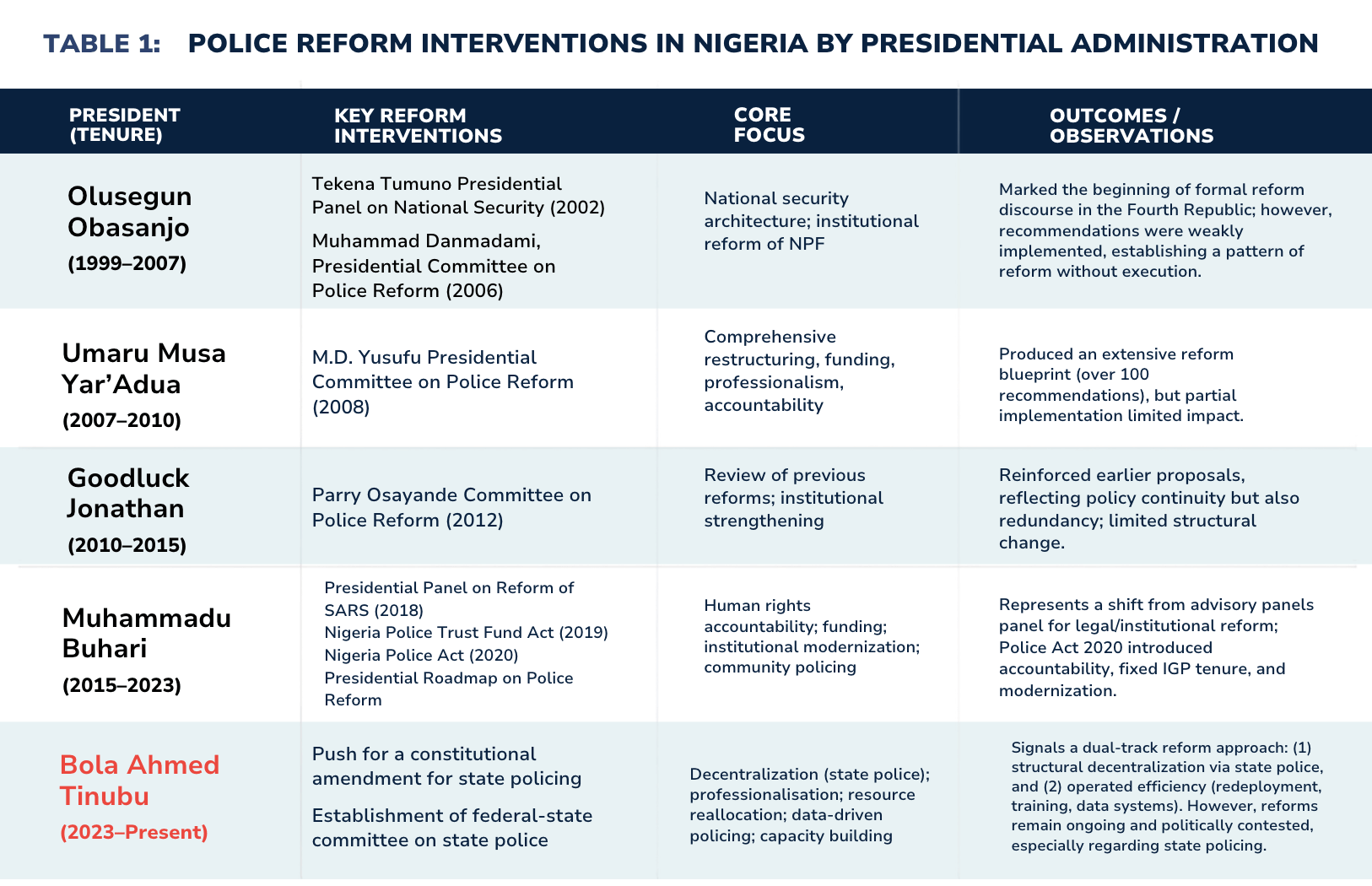
Promoters of the state police in Nigeria are composed of a diverse and evolving group of actors. Political leaders from the southern part of the country, including President Bola Tinubu and several state governors, have consistently promoted the decentralisation of policing. Socio-cultural organisations, such as Afenifere, the Pan-Niger Delta Forum, and the Middle Belt Forum, are also strong promoters of state police, and they mainly frame police decentralisation as one of the key conditionalities for reforming Nigeria’s federal system.
The argument of proponents of decentralisation of policing in Nigeria is predicated on four key pillars.
Efficiency and response time: The current centralised policing suffers from bureaucratic delays and response lethargy, as operational decisions must pass through hierarchical chains, hampering swift and effective responses to local threats.
Local knowledge and context sensitivity: This is a design flaw that emanates from the colonial policing system of ‘using strangers to police strangers.’ The current centralised system struggles to respond effectively, whereas state police are expected to be more attuned to local socio-cultural dynamics.
The lack of operational control over policing in states by governors: the governors are the elected ‘managers’ of their respective states.
Force multiplication: decentralisation is framed not as a replacement of the federal police, but as a complement, enhancing manpower and expanding intelligence networks across states.
On the other hand, the antagonists of the police decentralisation policy in Nigeria have always highlighted the risk of abuses associated with the move, referencing the weaponisation of the police by chief executives against political opponents. The fears of ethnicisation, given Nigeria’s plural social structure. Also, concerns that decentralisation could fragment national security coordination and weaken intelligence-sharing mechanisms. These risks are exacerbated by disparities in administrative and fiscal capacity across states, raising questions about uneven implementation of state policing by fiscally unequal states.
Ultimately, the debate around decentralised policing in Nigeria centres narrowly around constitutional reform and anticipated security outcomes, leaving unattended the equally important questions on fiscal capacity and institutional safeguards.
Fiscal Capacity of Nigerian States
Across the world, policing is both a labour-intensive and capital-heavy pure public good that consumes a remarkable portion of budgetary allocation. For OECD countries, approximately 6.9% of subnational government expenditure goes to "public order and safety’’, EU countries spend an average of 0.9% of GDP on police services, which translates to roughly 2% to 5% of total general government expenditure and for the United States, police spending across all state and local governments has consistently accounted for about 4% of direct general expenditures since 1977, with major cities appropriating over 10% for the police. Resourcing is critical to policing; therefore, the viability of any proposal for state police in Nigeria is dependent on the fiscal capacity of Nigerian states.
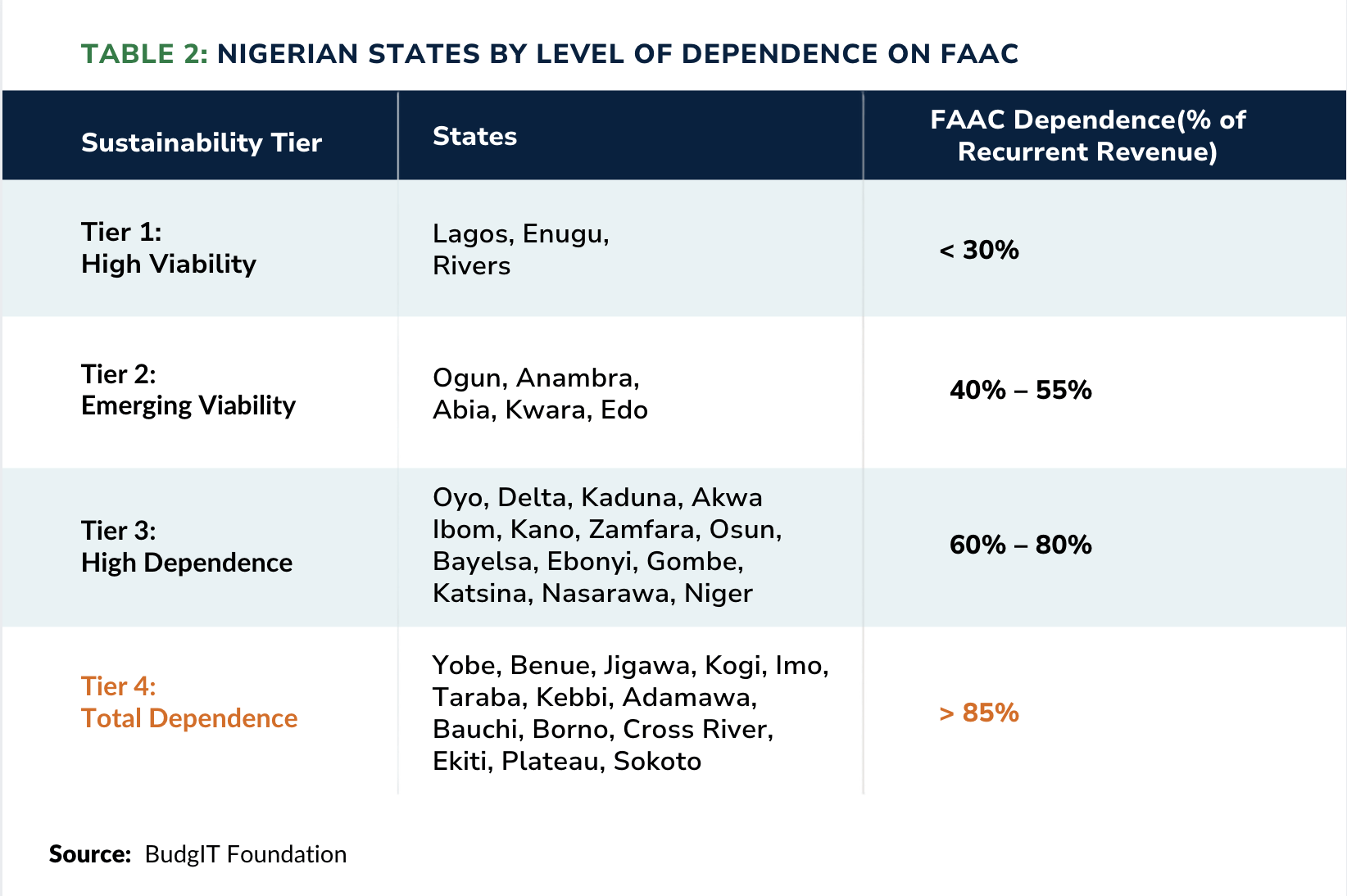
A key defining feature of Nigeria’s fiscal federalism is the structural dependence of states on federally distributed revenues. Nigeria operates a highly centralised fiscal federal system in which the federal government controls the bulk of revenue sources, particularly oil rents and major taxes. Revenues are pooled into the Federation Account and distributed monthly through the Federation Accounts Allocation Committee (FAAC) to the three tiers of government. For many states, this allocation constitutes the primary source of their public revenue, and many states depend on this source to finance recurrent expenditures, including salaries. While this system ensures a degree of national redistribution, it fundamentally constrains the fiscal autonomy of subnational governments, leaving them highly vulnerable to volatility in global oil prices and federal allocation policies.
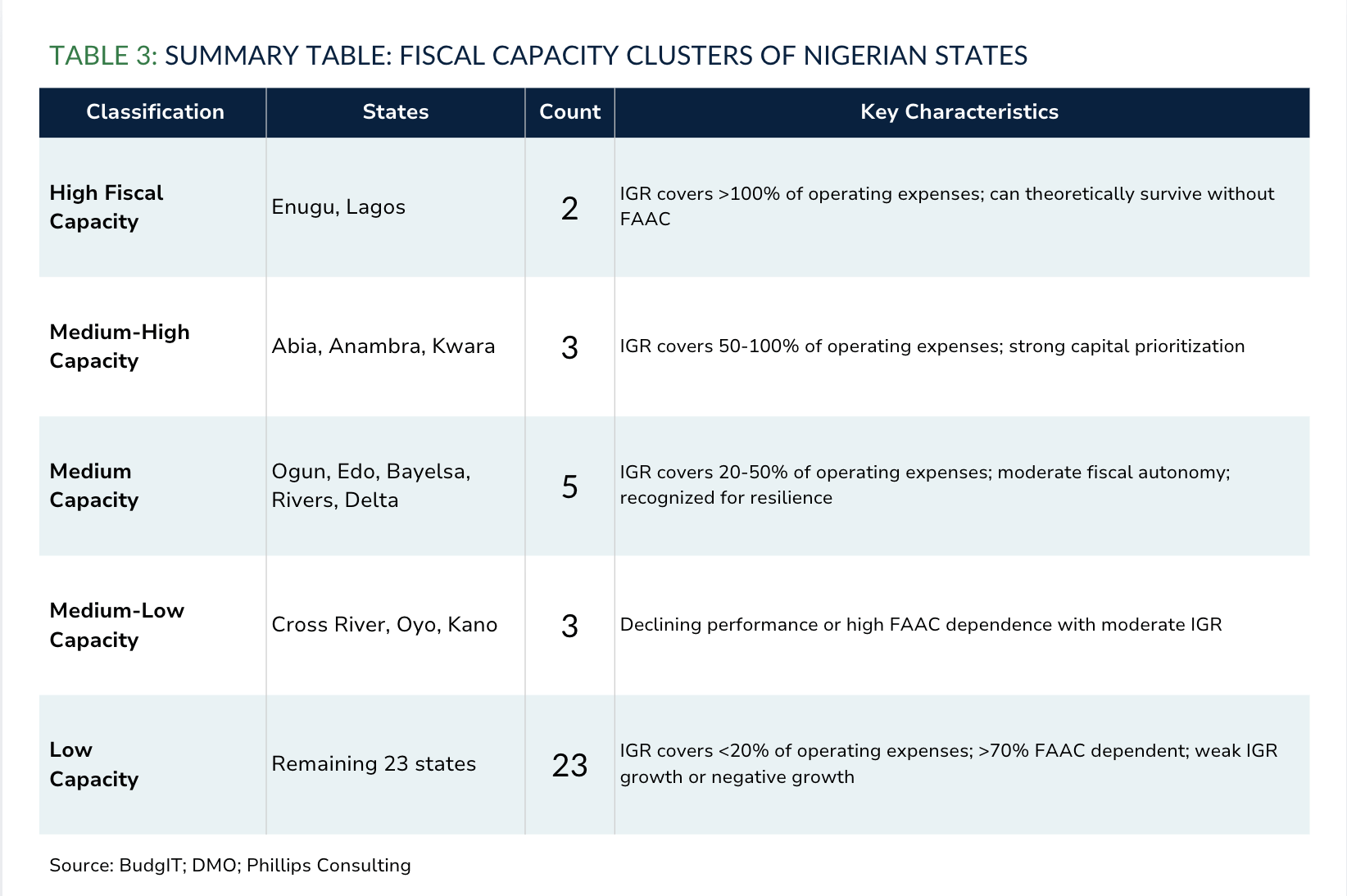
The composite of tables 2 and 3 provides an insight into fiscal asymmetry at subnational levels in Nigeria and its implications for state police feasibility, wage sustainability, and operational financing. A clear majority of states show high to near-total dependence on FAAC transfers, while as many as 23 out of 36 states generate less than 20% of their operating expenditure from internally generated revenue.
This reality highlights the mismatch between the aspiration of states to own and control their police force and the acute fiscal dependence obtainable at the subnational level. Based on the most recent public finance governance and management data, only Lagos, Rivers and Enugu States can be considered fiscally self-sustaining, with a small cluster of approximately five to ten states demonstrating partial resilience and an overwhelming majority structurally dependent on federal transfers.
The implication is that in practice, states would only be capable of financing proposed policing units mainly through redistributed federal rents rather than robust, internally generated revenue bases, thereby raising critical concerns about sustainability, accountability, and operational effectiveness.
Institutional and Governance Capacity
As highlighted in the preceding section, fiscal viability is a sine qua non for any sustainable decentralised policing project; however, ultimate success equally depends on the institutional architecture and governance capacity of the implementing states to manage coercive policing powers fairly, responsibly and in accordance with the rule of law.
A differentiating hallmark of policing in constitutional democracies is the embedded rules and accountability systems that promote checks on abuses and limit wide discretionary powers. Even if states surmount the funding conundrum, how will the independence and accountability questions be addressed? Unfortunately, evidence points to glaring accountability deficits in the operations of existing state-level institutions that would likely be magnified if state executives are clothed with further coercive powers.
Currently, there is no state-level integrated rule of law index in Nigeria, as existing indices are fragmented around citizens’ perceptions, public finance system audit and components of justice delivery, creating a measurement vacuum for policing reform and decentralisation debates. However, the following proxies will be used to analyse the governance capacity of states to manage state policing institutions: executive dominance and control over appointments, legislative oversight effectiveness, judicial independence and the rule of law, external oversight institutions and complaint systems.
Executive dominance and control over appointments constitute the first major governance concern. While the Nigerian Constitution normatively enshrines separations of powers as a key governance framework, state governors currently exercise near-absolute control over state-level institutions designed to be independent. The powers of appointment of state governors that potentially threaten the independence of the judiciary and State Independent Electoral Commissions (SIECs) offer an instructive proxy. This abuse is more poignant in the case of state electoral commissions, where, despite constitutional provisions for their independence, governors influence the operations of SIECs for electoral advantage, with ruling parties consistently winning 100 per cent of local government chairmanship seats in states across the federation. This pattern reflects a broader phenomenon of executive capture of state-level institutions. If similar dynamics were to govern state police forces, the risk of gubernatorial weaponisation of police powers against political opponents, journalists, and civil society actors would be substantial. As former Speaker of the National Assembly, Yakubu Dogara warned, empowering governors with state police without addressing executive dominance would amount to "giving a hangman the free man to hang."
The institutional inefficacy of legislative oversight at the subnational levels is another area of significant governance vulnerability. Multiple studies have documented the functioning of State Houses of Assembly more as institutional appendages of the executive, with gubernatorial influence effectively neutralising the separation of powers, rather than an independent arm of government. This systemic docility is evident in the perfunctory nature of budget scrutiny and the rare invocation of legislative inquiry powers, even in the face of overt executive malfeasance. While the Conference of Speakers of State Legislatures has voiced support for oversight of security institutions, the prevailing political economy, characterised by executive control over constituency development funds and the gatekeeping of political appointments, creates a formidable barrier to genuine reform.
Judicial independence and the rule of law in Nigeria present a mixed but ultimately fragile picture. While federal courts have shown increasing willingness to curb executive overreach, illustrated by a Federal High Court ruling affirming citizens’ right to record police officers. At the state level, judicial autonomy remains constrained by governors’ control over budgets and informal influence on appointments, fostering institutional caution.
The cumulative impact of these governance deficits points to one unmistakable conclusion- the institutional safeguards that are prerequisites for rights-based policing at the state level are absent across the majority of Nigerian states. Executive dominance, weak legislative oversight, and compromised judicial independence create an environment in which decentralised police powers would likely be deployed in the service of executive interests rather than public safety. This particular conclusion is not necessarily an argument against police decentralisation; rather, it contends that governance reforms must precede in parallel with structural changes to policing, if not, the patterns of abuse associated with regional policing during the First Republic are likely to re-emerge.
Policy Implications: Conditional Pathways
Based on Nigeria’s sociopolitical, economic and capacity differences across states, it will be far more practical to design police decentralisation as a phased process with performance and capability criteria. Unquestionably, the basics of the arguments for state police- efficiency, proximity, and responsiveness- are factually valid; however, there are also the abiding questions of the state’s fiscal fragility and institutional weakness, which impose clear implementational limits. International experience suggests that decentralised policing systems function effectively only where subnational governments possess stable revenue bases, robust accountability institutions, and clearly defined constitutional safeguards. In Nigeria’s case, these conditions are unevenly distributed, suggesting the need for a differentiated and sequenced reform strategy rather than a uniform constitutional rollout.
First, for the National Assembly, one of the anchors in any constitutional reform required for the operation of state police, the top priority should be to design a framework that embeds conditionality into any decentralisation process. This includes establishing clear fiscal and institutional benchmarks that states must meet before assuming policing powers. Such benchmarks should encompass minimum thresholds for internally generated revenue, wage sustainability ratios, and transparency in public financial management. In addition, constitutional safeguards must be explicitly defined to prevent abuse, including provisions on operational autonomy, federal oversight triggers, and enforceable accountability mechanisms. Comparative federal systems demonstrate that central governments often retain regulatory authority to ensure minimum policing standards and inter-jurisdictional coordination.
Second, for State Governments, the implications are primarily fiscal and administrative. Strengthening IGR systems is indispensable, as reliance on volatile federal transfers undermines the sustainability of labour-intensive services such as policing. Empirical evidence from Nigeria shows that subnational fiscal dependence correlates with weak service delivery outcomes. Beyond revenue mobilisation, states must improve fiscal transparency and expenditure efficiency, particularly in managing wage bills. Without credible commitments to fiscal discipline, the introduction of state police risks exacerbating salary arrears and undermining broader public sector performance.
State Legislatures must strengthen oversight capacity and institutional independence as a prerequisite for preventing executive overreach. This requires reforms to legislative procedures, increased technical capacity for budget scrutiny, and insulation from gubernatorial influence, foundational safeguards for any decentralised policing arrangement.
Among reform options, a phased approach to decentralisation offers the most prudent pathway forward. Rather than a wholesale commencement approach that establishes state police across all 36 states simultaneously, governance stakeholders should consider a tiered system that allows states to opt into decentralised policing upon meeting predefined fiscal and governance criteria. This opt-in model allows high-capacity states to pioneer state policing while providing low-capacity states with time and incentives to undertake necessary reforms. Such an approach mitigates the risk of security fragmentation while creating a demonstration effect that may incentivise capacity-building across the federation.
For states with medium to low fiscal capacity, hybrid or regional policing models present a more viable alternative than fully decentralised forces. Regional arrangements could combine state-level coordination with federal partnership, formalised through legislation that clarifies legal status, funding mechanisms, and operational relationships with the Nigeria Police Force.