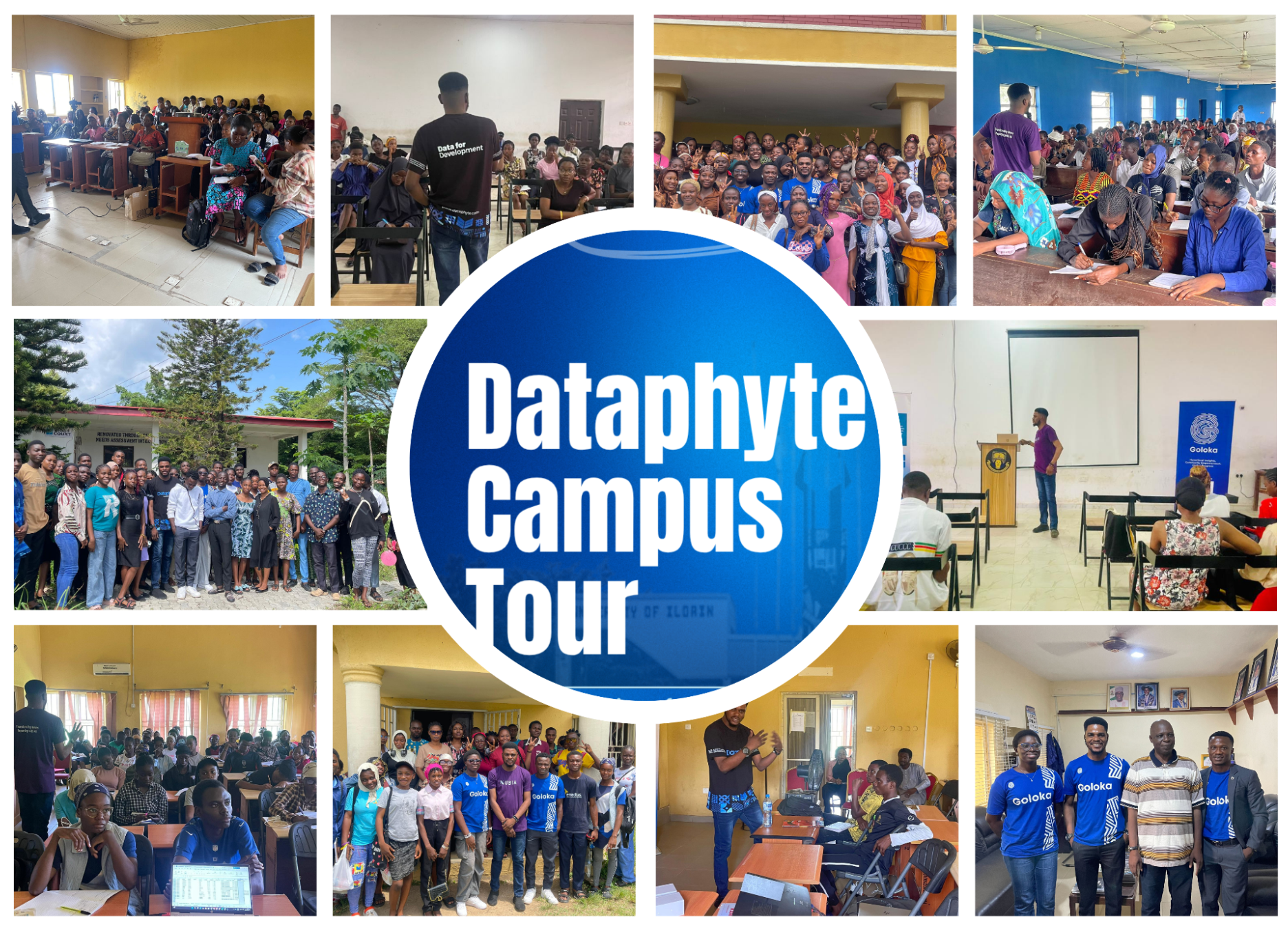
Dataphyte Academy: A Multi-Campus Tour Across the South-West
One of the standout activities in June was the multi-campus training tour carried out by the Dataphyte Academy team. The initiative, which reached six universities across South-West Nigeria, introduced over 400 students to foundational concepts in data journalism, media literacy, and artificial intelligence for civic engagement.
The training team, led by Kehinde Ogunyale, Jemima John-Udhe, and Ibrahim Yusuf, delivered tailored sessions designed to give students not only technical knowledge but also a practical understanding of how data can support transparency and accountability in governance.
At the University of Ilorin on June 3, students explored the fundamentals of data journalism and discussed the ethical use of AI in media.
At Obafemi Awolowo University (June 9–10), the training extended into two full days, incorporating hands-on data visualisation exercises, story development workshops, and group-based critique sessions.
The team continued to LASUSTECH (June 13–14) and Osun State University (June 16–17), where they facilitated practical exercises in digital storytelling and introduced tools for verifying open-source data.
The final stops at Adekunle Ajasin University (June 19–20) and Federal University Oye-Ekiti (June 23–24) focused on how AI tools are changing the landscape of investigative journalism, with case studies, demonstrations, and guided practice sessions.
All through the tour, Dataphyte Academy remained focused on accessibility, ensuring that even students with little or no prior exposure to data tools left each session equipped to explore stories with depth and accuracy.
Strengthening Civic and Climate Conversations
On June 10th, 2025, Dataphyte hosted a visit from the Impact House Centre for Development Communication. The discussion focused on strategies for making development-focused content more accessible to citizens, particularly in marginalised communities. The visiting team shared their approach to simplifying civic issues, while Dataphyte explored how storytelling grounded in data can support better public understanding and more responsive governance.
Telling Better Stories with Data
On June 19th, Khadija Kareem and Kehinde Ogunyale led a session at World Water Week, exploring how data-driven journalism shapes the way we tell stories about climate, water, gender, and even misinformation.
Khadija spoke about how these issues are more connected than we think, and how data helps us frame them not just as numbers, but as everyday realities. Kehinde took it further, showing how to dig into datasets, trace patterns, and tell stories that reflect what’s really happening in our communities.
This is part of the mission of Dataphyte Academy, which is to equip people to use data with clarity, context, and purpose.
External Engagements
As part of our external engagements, the Dataphyte team attended the International Budget Partnership System Change Training on Wednesday June 4, a training designed to help civil society organisations rethink how social interventions are designed and implemented.
During one of the sessions, Dataphyte’s Country Director, Oluseyi Olufemi, shared how the organisation already applies a systems approach in its work, asking “why” through data, tracing root causes, and using evidence to better understand the challenges we aim to solve.
Policy Engagements
On June 24–26, 2025, Dataphyte Foundation joined government agencies, civil society organisations, and Open Government Partnership (OGP) champions to co-create Nigeria’s Fourth National Action Plan (NAP IV). This effort builds on the first retreat held in March, where stakeholders identified key themes aimed at addressing the socio-economic barriers affecting public service delivery.
As a core stakeholder, Dataphyte spent three days working alongside partners to develop clear, measurable commitments around inclusive digital governance, service delivery reform, fiscal transparency, citizen participation, and climate accountability. These commitments are designed to ensure public services reach the last-mile beneficiary.
With the draft of NAP IV now moving into its next review stage, Dataphyte remains committed to pushing for digital innovation in governance, ensuring that service delivery is faster, more transparent, and truly centred on the needs of citizens.
Dataphyte’s Country Director, Oluseyi Olufemi, and Programme Officer, Funmilayo Babatunde
Dataphyte Hub
Dataphyte Hub hosted the OrderPaper POPULA 2.0 project at the Dataphyte Hub on the 4th of June, 2025, an initiative focused on promoting transparency and accountability in Nigeria’s legislature.
Think open parliament, youth engagement, and media-driven advocacy all in one space. It was a meaningful conversation about governance, representation, and what it takes to make democracy work.
Looking for a space where ideas like this can come to life? You can book the Dataphyte Hub for your next project, event, or brainstorm session.
OrderPaper POPULA 2.0 project
Divided We Stand 2.0: A Closer Look at Federalism and Inclusion
Dataphyte published the second edition of its flagship governance report, Divided We Stand,
Divided We Stand 2.0 focused on four geopolitical zones and explored:
The suspension of Senator Natasha Akpoti and barriers faced by women seeking political leadership in Nigeria
The establishment of the North Central Development Commission and the impact of regional development programmes
Legal battles tied to Kano State’s local government elections, and what they reveal about electoral accountability
An examination of local and ward-level leadership structures
Policy Brief: Assessing Nigeria’s Digital Public Infrastructure
On June 11, Dataphyte released a new policy brief titled “Assessing the Current State of Nigeria’s Digital Public Infrastructures.” The publication explores how far Nigeria has come in building the systems that power digital governance, specifically across three pillars: digital identity, electronic payments, and data exchange frameworks.
The report traces Nigeria’s digital journey from early efforts like the National Backbone Infrastructure to more recent initiatives such as the NIN-SIM linkage and the 3 Million Tech Talent programme. It highlights notable progress in digital identity and payments, but also flags the persistent underdevelopment of Nigeria’s data exchange systems, especially the lack of interoperability across the government's Ministries, Departments and Agencies.
To close these gaps, the report calls for greater investment in foundational infrastructure, stronger public-private collaboration, and a deliberate push to expand digital access to underserved communities, particularly women and young people.
In February, Dataphyte published a suite of newsletters, special reports, and data cards, offering deep analysis on Nigeria’s evolving socioeconomic, political, and gender-related issues. Through the weekly editions, Pocket Science, SenorRita, Marina & Maitama, and Data Dive, providing timely and data-led insights.
Pocket Science
This edition focused on the cost implications of essential goods and services for everyday Nigerians:
Rising Cooking Gas Prices: Examined price changes in 12kg and 5kg cylinders of cooking gas and their impact on household out-of-pocket expenses, particularly for low-income households.
Hike in FRSC Licensing and Registration Fees: Analysed the Federal Road Safety Corps’ (FRSC) fee increases and the added financial burden on vehicle owners.
SenorRita
June’s editions of SenorRita, being the gender-focused newsletter, explored:
Obstetric Fistula in Nigeria: Investigated poverty, early marriage, and female genital mutilation (FGM) as key root causes.
Mental Health and Gender Disparities: Reported that females account for over half of all deaths from mental disorders in Nigeria.
Gender and Displacement: Explored how conflict drives more Nigerian men than women into displacement, challenging common narratives.
Marina & Maitama
This month’s editions provided insight into:
How economic factors shape Nigerian saving habits and Nigeria's aims for 70% broadband penetration in 2025, and where it is currently at.
State of Nigeria's Purchasing Managers’ Index (PMI) in May 2025 and Nigeria’s growing infrastructure vulnerability in a climate crisis era.
Nigeria’s stance as Strait of Hormuz tensions threaten an oil shock, and how Nigeria's transition to Compressed Natural Gas (CNG) is gaining traction, while the infrastructure struggles to catch up.
Data Dive
Deep-dive analysis on pressing national developments:
Tinubu’s First Two Years: Economic Review: Evaluated key economic indicators and reforms in the administration’s first 24 months.
Environmental Justice in the Energy Transition: Raised concerns about governance gaps, environmental degradation, and human rights abuses amid the shift to clean energy.
26 Years of Nigerian Democracy: Reflected on the state of governance and institutional growth since 1999.
World Refugee Day Focus: Investigated the rising displacement crisis and violent killings in Nigeria.
Tax Reform Impact Analysis: Reviewed the socioeconomic implications of four major tax bills signed by President Bola Tinubu.
In addition to the newsletters, Dataphyte published a series of special reports exploring critical national issues. These included an in-depth analysis of how Benue’s killing fields have evolved over the years, a review of the federal government’s plan to spend ₦7.4 billion on constructing 25 primary healthcare centres across Nigeria’s six geopolitical zones, an examination of how the 2025 budget addresses gender-related concerns through targeted allocations, and a report on the growing challenges associated with malaria prevalence and response in the country.
Dataphyte also continued to produce timely Data Cards, which translate complex statistics into concise, accessible visuals. These cards tackled prominent national conversations, ranging from security incidents to education spending and inflation trends, enabling Nigerians to engage more meaningfully with the data behind the headlines.
Looking Ahead
June was a reminder that meaningful work happens across different layers, teaching, analysing, convening, and creating. Whether in a classroom or inside a report briefing policymakers, the focus remained clear: make data more useful, make governance more accountable, and support people in shaping the future they want.
We are grateful to everyone who partnered with us this month, opened a classroom to us, joined a training, shared a brief, or read our insights.